
Telnet alternative when you can't install telnet

 I wanted to check the connectivity to an email service from a server that belongs to a client. I had restricted access to this server so I couldn't install new packages like Telnet. 

If I had telnet it's much easier, but fortunately, the CURL package was already there. Curl is usually available to any user in a typical Linux system.

In this case, CURL comes to your rescue. Did you know that Curl supports telnet commands as well?

Curl is known as a tool to test HTTP layer functions. Whereas Telnet supports lower TCP level connections.

With Curl supporting telnet, it can also be used for testing the TCP connections.


eg: 

curl -v telnet://www.google.com:80

-v switch is being used to spill verbose output from the request.
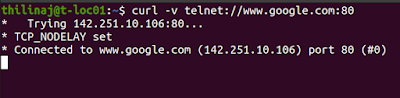
Telenet with curl


In this example, I've used port 80, but since it is capable of using TCP, it can use any port.


Telnet with curl example


Comments

Popular posts from this blog

VLC skins

It's been a while from my first blog post, so today I thought to make a blog post about skins in VLC player. I think you all are familiar with VLC player if not, here's the link for the website www.videolan.org/vlc/index.htm l In brief, VLC player is a free and opensource player that can play almost all the types of media formats. Even though it is a such a nice player, it looks kind of old and rusty, like the windows classic look. But you can make it prettier by just adding some new skins to it.  You can download skins for the player from here http://www.videolan.org/vlc/skins.php Then place the downloaded skin file (.vlt file) in the " skin " folder in the installation directory.           eg:- in windows:    C:\Program Files\VideoLAN\VLC\skins           or in linux systems:  ~/.local/share/vlc/skins Then, open the VLC player and go to the preferences. ...

How to set terminal title in Ubuntu 18.04 LTS

In older Ubuntu versions, you could have just right-clicked on the Ubuntu Terminal window's title bar and set any title you would like. But unfortunately after Ubuntu 18.04 LTS this feature is gone. I used to love this feature because I'm multiple tabs in the single terminal window kind of a guy. I usually like to work in multiple named terminal tabs like below. By default, in newer Ubuntu version, it is showing just the current directory. Let's see how we can do this. Ubuntu prompt In ubuntu's Bash, there's an environment variable $PS1 which is responsible for the details that the command line prompts. You'll be able to echo this and see what's inside it. If I echo it it will print something like this. echo $PS1 \[\e]0;\u@\h: \w\a\]${debian_chroot:+($debian_chroot)}\[\033[01;32m\]\u@\h\[\033[00m\]:\[\033[01;34m\]\w\[\033[00m\]\$ If you really want to understand what this means, you can refer this page .  Updating the termina...

Java, how to create a list with a single element

 I wanted to create a Java List with a single element. Yet, I wanted to add more elements later. So, I was looking for a couple of ways to do this. So far there are multiple elegant ways to create a list with a single element with a one-liner. Not so much for a modifiable list though. Here's what I gathered so far. Followings are a few ways of creating a list with strictly a single entry. Can't add more elements. 1. Collections.singletonList() This returns an immutable list that cannot be modified or add more elements. // An immutable list containing only the specified object. List<String> oneEntryList = Collections. singletonList ( "one" ) ; oneEntryList.add( "two" ) ; // throws UnsupportedOperationException 2.  Arrays.asList() This returns a fixed-size list consisting of the number of elements provided as arguments. The number of elements provided would be an array hence the size is fixed to the length of the array. // Returns a fixed-size list List...