Installing WSL Ubuntu 22.04 on Windows 11


Installing WSL Ubuntu 22.04 on Windows 11


1. Enable Windows Subsystem for Linux and Virtual Machine platform

Go to Control Panel -> Programs -> Programs and Features -> Turn Windows features on or off
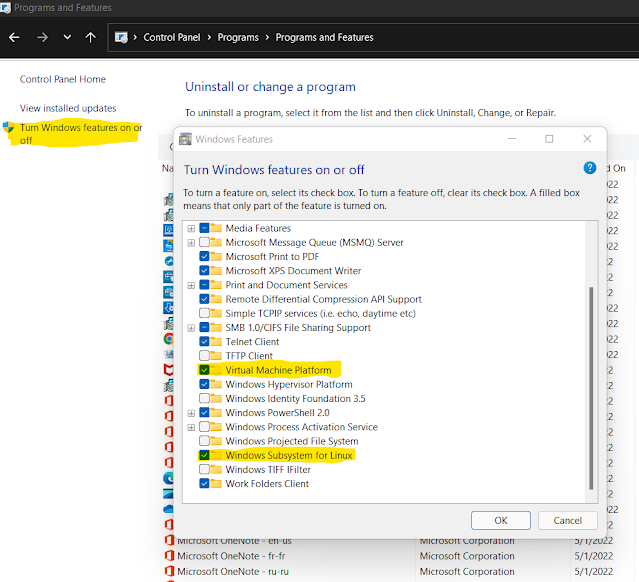
Enable Windows Subsystem for Linux and Virtual Machine platform


2. Switch to WSL 2

Open Powershell and type in the below command.

wsl --set-default-version 2


If you don't have WSL 2, download the latest WSL 2 package and install it. 

3. Install Ubuntu

Open Microsoft Store and search for Ubuntu. Select the version you intend to install. I'd use the latest LTS version Ubuntu 22.04. Click on the Get button.

Microsoft store Ubuntu

It will take a couple of minutes to download and install.

4. Open up the installed Ubuntu version that was installed.
Ubuntu WSL


If you get an error like the below image, make sure to install the WSL2 Kernel update


Ubuntu 22.04 WSL error
If it's an older Ubuntu version the error message would be something like the image below.
Ubuntu 20.04 WSL error
Error: WSL 2 requires an update to its kernel component.


Installing the WSL2 kernel update should fix this issue. Then close the Ubuntu window and open it up again.

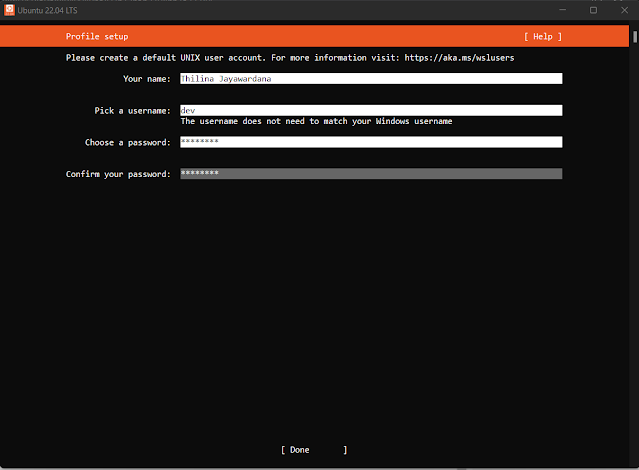
It will ask for the Language, username, and password like below.

Ubuntu 22.04 WSL

Ubuntu 22.04 WSL select language

Ubuntu 22.04 WSL Account

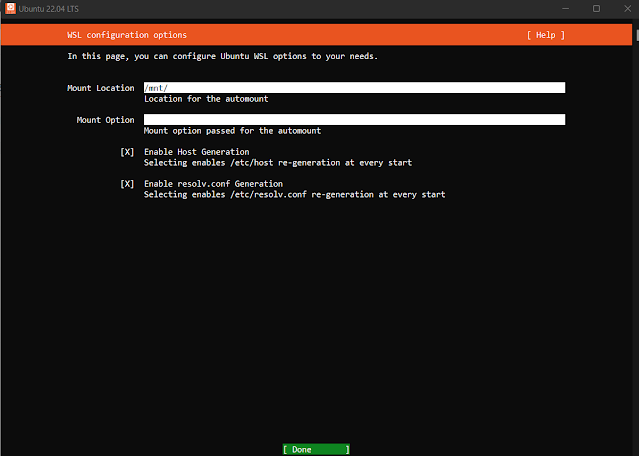
Ubuntu 22.04 WSL mount settings
In the mount settings, you can leave the defaults.
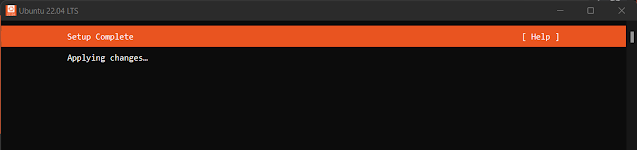
Ubuntu 22.04 WSL applying changes
It will take a minute or two to apply the changes.
Ubuntu 22.04 WSL setup complete
Hit enter to reboot Ubuntu WSL.
Ubuntu 22.04 WSL

Now, we have installed the WSL 2.

Comments

Popular posts from this blog

VLC skins

It's been a while from my first blog post, so today I thought to make a blog post about skins in VLC player. I think you all are familiar with VLC player if not, here's the link for the website www.videolan.org/vlc/index.htm l In brief, VLC player is a free and opensource player that can play almost all the types of media formats. Even though it is a such a nice player, it looks kind of old and rusty, like the windows classic look. But you can make it prettier by just adding some new skins to it.  You can download skins for the player from here http://www.videolan.org/vlc/skins.php Then place the downloaded skin file (.vlt file) in the " skin " folder in the installation directory.           eg:- in windows:    C:\Program Files\VideoLAN\VLC\skins           or in linux systems:  ~/.local/share/vlc/skins Then, open the VLC player and go to the preferences. ...

Java, how to create a list with a single element

 I wanted to create a Java List with a single element. Yet, I wanted to add more elements later. So, I was looking for a couple of ways to do this. So far there are multiple elegant ways to create a list with a single element with a one-liner. Not so much for a modifiable list though. Here's what I gathered so far. Followings are a few ways of creating a list with strictly a single entry. Can't add more elements. 1. Collections.singletonList() This returns an immutable list that cannot be modified or add more elements. // An immutable list containing only the specified object. List<String> oneEntryList = Collections. singletonList ( "one" ) ; oneEntryList.add( "two" ) ; // throws UnsupportedOperationException 2.  Arrays.asList() This returns a fixed-size list consisting of the number of elements provided as arguments. The number of elements provided would be an array hence the size is fixed to the length of the array. // Returns a fixed-size list List...

Find command: How to find and delete 0 bytes files in Linux

In Linux, "find" command is a powerful command that we can use not only to find files. I've used it for different requirements, so thought of posting some of the convenient usages of find commands in a series of posts. For some application issue, I've got one of my directories in Ubuntu system swarmed with empty files with 0 bytes. Some of the files got data in them but some of them were empty. I just wanted to delete the empty files and it wasn't possible to identify them by file names or dates. So find command comes to rescue. find . -size 0 -type f  If I needed to isolate the files by file extension, we can use something like this. find . -size 0 -type f -name "*.tar" You can get the file count by piping it to wc command. find . -size 0 -type f -name "*.tar" | wc -l The awesome thing about the find command is you can use it for deleting files just by adding the -delete flag to the command. find . -size 0 -type f -name "*.tar" -dele...